
What Are the Parts of a Flag? Hoist, Fly, Header and Grommets Explained
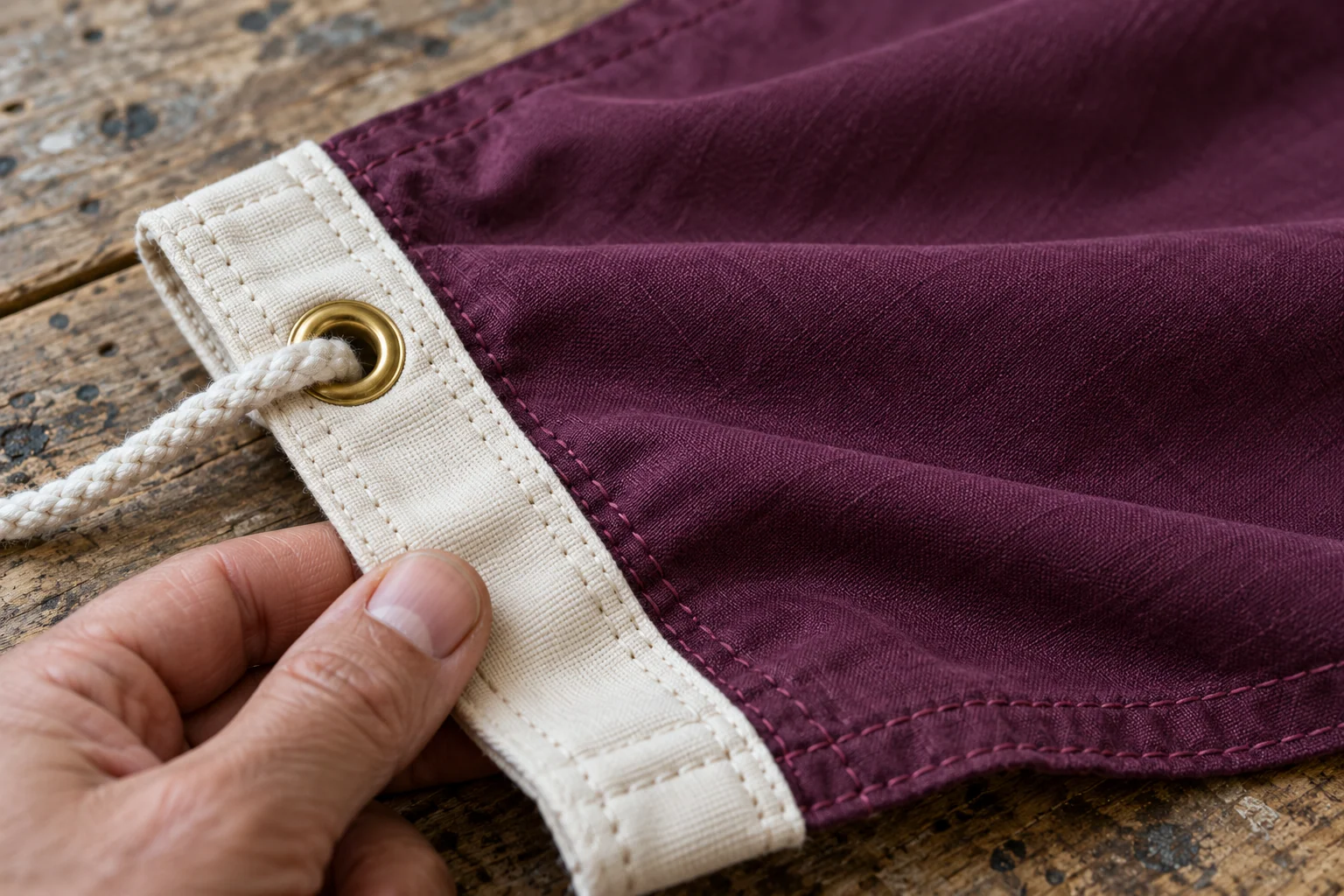
Knowing the parts of a flag makes a specification easier to understand. The hoist is the edge nearest the pole or attachment, while the fly is the free outer end. The main background is often called the field. A finished commercial flag may also include a header, hems, a sleeve, eyelets or clips. Not every flag uses every component, so agree the construction against the actual support.
Hoist and fly describe orientation
When artwork includes words, an arrow or an asymmetrical emblem, orientation matters. Label the hoist side clearly on the production drawing rather than writing only left or right. A flag can be installed differently from the flat proof, especially on a vertical system. Show how the design should look from the principal viewing direction and describe what is expected on the reverse.
The header carries attachments
A reinforced strip along the attachment edge is commonly called a header. Depending on the construction, it may carry eyelets, rings, clips or a rope arrangement. Its width and attachment positions need to suit the pole. Include the visible header in the design conversation: a contrasting strip may affect the appearance, and it takes space away from the uninterrupted graphic area.
A sleeve needs room for the pole
A sleeve or pocket receives part of a pole or frame. Shaped promotional flags often rely on a carefully fitted sleeve and curved outline. The required finished pocket differs from the flat width used during manufacture, so do not supply an estimated measurement without clarification. Send the pole diameter or frame model and ask the supplier to confirm compatibility.
Hems finish the edges
Hems fold and stitch the fabric edge. The seam can affect the space available for artwork and the way an edge behaves. Corners and the free end deserve close inspection because they move repeatedly during use. Reinforcement may be proposed for a particular application, but it should be specified rather than assumed to make any flag suitable for every condition.
Use the terminology in your brief
A practical sketch shows final width and height, the hoist edge, attachment type and spacing, sleeve details and artwork orientation. Photograph the installed hardware if it is safe to do so from ground level. Share the appropriate SKU and sketch with Orient Uniforms FZE. Have a competent installer assess mounting questions that cannot be answered from the flag dimensions alone.
Questions & answers
Are grommets and eyelets the same thing?
The terms are often used for reinforced holes in display textiles. Specify diameter, positions and hardware compatibility rather than relying on the name.
Does every flag need a pole sleeve?
No. The correct finish depends on the pole or frame; clips, eyelets and other attachment arrangements may be used.